Natal Wheel › Guides › Aspects › Trine
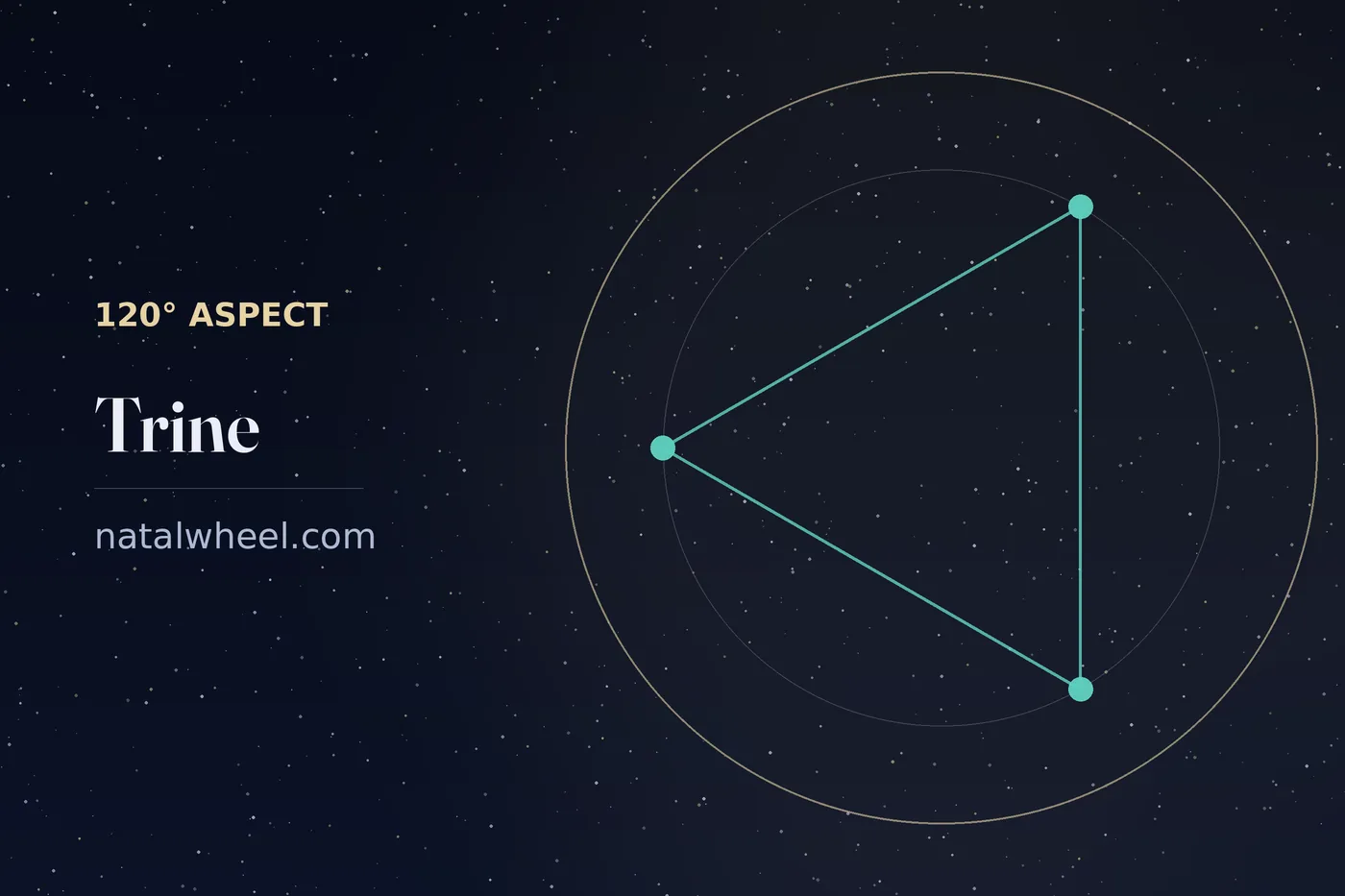
120° · Ptolemaic aspect
The trine in astrology
A trine places two planets one hundred and twenty degrees apart, in signs of the same element. The tradition treats it as the most harmonious of the ancient aspects, and the description holds: the two functions cooperate without negotiation. Whether that cooperation becomes an ability or stays an unexamined habit depends on things the geometry has nothing to say about.
In plain words
A trine is an easy angle: the two planets help each other without being asked. Any two planets in your chart can make this angle. The closer the angle, the more you feel it.
Full guide
A third of the circle
The trine divides the zodiac into three equal parts of one hundred and twenty degrees. Counting four signs from any starting point lands on a sign of the same element, so a trine joins fire to fire, earth to earth, air to air or water to water. Aries, Leo and Sagittarius form one such triangle; Taurus, Virgo and Capricorn form another. Signs in a trine also share a polarity, and they differ in modality, since each triangle contains one cardinal, one fixed and one mutable sign. That combination is the whole explanation of the aspect's reputation. The two planets are speaking the same elemental language with different working styles, which is about as little friction as the zodiac allows.
When three planets occupy all three signs of one element the figure is called a grand trine, and it concentrates the element heavily. Astrologers have long noted that such a pattern can be self-sufficient to the point of being closed, since each planet is supported by the other two and none of them is obliged to look outside the element.
Its place in the tradition
The trine belongs to the five Ptolemaic aspects, the oldest and best attested layer of the technique. Ancient authors ranked it the most benefic of the configurations, above the sextile, and some described the trine as the aspect of full agreement between two places. The classical reasoning was that signs of one triplicity share a nature and therefore behold each other with goodwill.
What it does in a chart is remove resistance. A planet trine another operates as though the road had already been cleared: the talent is available on demand, the two functions reinforce rather than interrupt, and the person seldom recognises any of it as remarkable, because they have never had to work for it. Trines are consequently the hardest aspects to spot in a consultation. The square gets described at length; the trine has to be inferred from what the person passes over without comment.
Orbs
Seven or eight degrees is the standard tolerance for a trine between planets, with some practitioners allowing nine. A trine to the Sun or the Moon is customarily given more room, often ten degrees, because a luminary has always been credited with a larger sphere of light than the smaller bodies. Closeness sharpens the reading in the usual way: a trine within two degrees tends to describe a facility the person can name, while one at seven or eight sits far in the background and rarely accounts for much on its own. Where several aspects compete for the same interpretation, the exact one is the safer bet.
The cost of ease
The popular framing that flowing aspects are fortunate and tense ones unfortunate should be set aside rather than softened. A trine reports what comes easily, and a capacity that comes easily is one a person may never build on, because nothing in the life has ever demanded that they improve it. A square or an opposition reports a place where two functions collide, and collision is uncomfortable and productive in equal measure; it generates the attention that turns an inclination into a craft. Charts full of trines and short of hard angles have often been described as comfortable and unmotivated, which is at least as one-sided a verdict, and neither statement should be taken as a forecast. The angle describes a relationship between two parts of a chart, and what becomes of it belongs to the person, not to the symbolism.
The orb this app allows
7° by default, plus 2° when the Sun or Moon is one of the two bodies, and half the allowance for asteroids and calculated points. The orb preset in Settings scales the whole table if you prefer to read tighter or wider.
Cast your free chart to see your trines →
The other aspects
Conjunction · Opposition · Square · Sextile · Quincunx · Semisextile · Semisquare · Sesquiquadrate · Quintile · Biquintile
Every page here is computed from the same Swiss Ephemeris that powers the Natal Wheel app — a precise tropical natal chart with transits, progressions, returns, synastry and the traditional techniques, free.