Natal Wheel › Guides › Aspects › Quintile
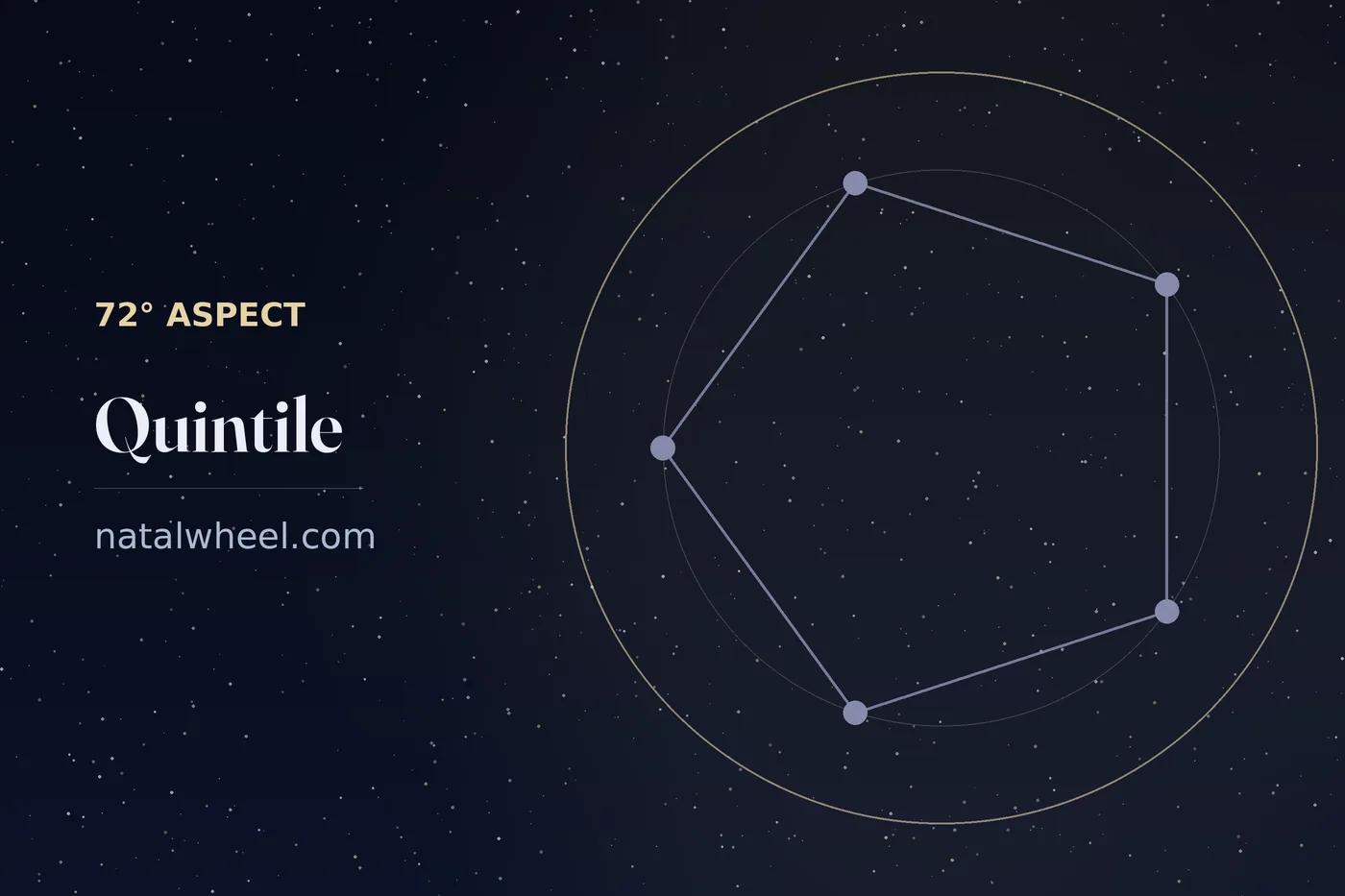
72° · minor aspect
The quintile in astrology
The quintile divides the circle into five, placing two planets seventy-two degrees apart. Kepler introduced it on the argument that geometry, not tradition, should determine which angles count. Astrologers who use it associate it with a distinctive facility, a way of shaping material that belongs to one person. It remains a minor aspect with thin support.
In plain words
A quintile is a small creative angle: the two planets spark ideas in each other. Any two planets in your chart can make this angle. The closer the angle, the more you feel it.
Full guide
A fivefold division
Seventy-two degrees is one fifth of three hundred and sixty, the angle subtended by the side of a regular pentagon. The important consequence for chart reading is that seventy-two is not a multiple of thirty. The fivefold division cuts straight across the twelvefold zodiac and never lines up with it, so a quintile can join almost any pair of signs and has no consistent relationship to element, modality or polarity at all. This sets it apart from every Ptolemaic aspect, each of which corresponds to a fixed number of signs and takes much of its meaning from what those signs share.
A quintile is therefore purely a measurement between two degrees. Five planets spaced evenly around the circle would form a regular pentagon, a figure some astrologers call a grand quintile, and it is as rare as the arithmetic suggests.
Kepler's argument
The quintile family is Kepler's contribution. In the Harmonices Mundi he proposed that the valid aspects should be derived from the regular polygons that can be constructed in a circle and from the musical ratios those divisions produce, rather than accepted on the authority of the older lists. The quintile and the biquintile follow from the pentagon, and Kepler took them seriously as working angles. They are consequently a good deal younger than the Ptolemaic five and were absent from astrology for its first fifteen hundred years.
Twentieth century writers, particularly those interested in creative work, associated the quintile with a personal signature: an ability to give form to something, a knack that shows up as style rather than as strength. The connection is plausible given the aspect's geometric ancestry in proportion and pattern, and it is not established by anything more than that plausibility and a tradition of anecdote.
How close it must be
One to two degrees is the standard tolerance, and many who use quintiles restrict them to a single degree. The Sun and the Moon receive the small additional allowance they are given throughout the system, following the ancient view that the luminaries cast light over a wider field than the planets do. Because the aspect is subtle, its value depends almost entirely on exactness. A quintile within half a degree describes something specific enough to check against a person's account of themselves; at two degrees it is one of many faint angles a chart contains, and it cannot be distinguished from the background.
The weakest ground in the technique
Of everything in aspect doctrine, the quintile family has the least behind it. It is late, it comes from an argument about geometry rather than from any record of results, and no body of observation supports it that would convince someone who was not already persuaded. The honest way to use it is as a whisper: a note added to a reading that stands on its own without it, never a foundation. The customary sorting of aspects into fortunate and unfortunate deserves the same refusal. Angles that run smoothly describe what a person can already do, and what is already available is often left exactly as it was found; angles that catch describe the places where two functions will not settle, and those are the places where development actually occurs. A quintile belongs to neither category and predicts nothing in either case.
The orb this app allows
1.5° by default, plus 2° when the Sun or Moon is one of the two bodies, and half the allowance for asteroids and calculated points. The orb preset in Settings scales the whole table if you prefer to read tighter or wider.
Cast your free chart to see your quintiles →
The other aspects
Conjunction · Opposition · Trine · Square · Sextile · Quincunx · Semisextile · Semisquare · Sesquiquadrate · Biquintile
Every page here is computed from the same Swiss Ephemeris that powers the Natal Wheel app — a precise tropical natal chart with transits, progressions, returns, synastry and the traditional techniques, free.