Natal Wheel › Guides › Aspects › Semisquare
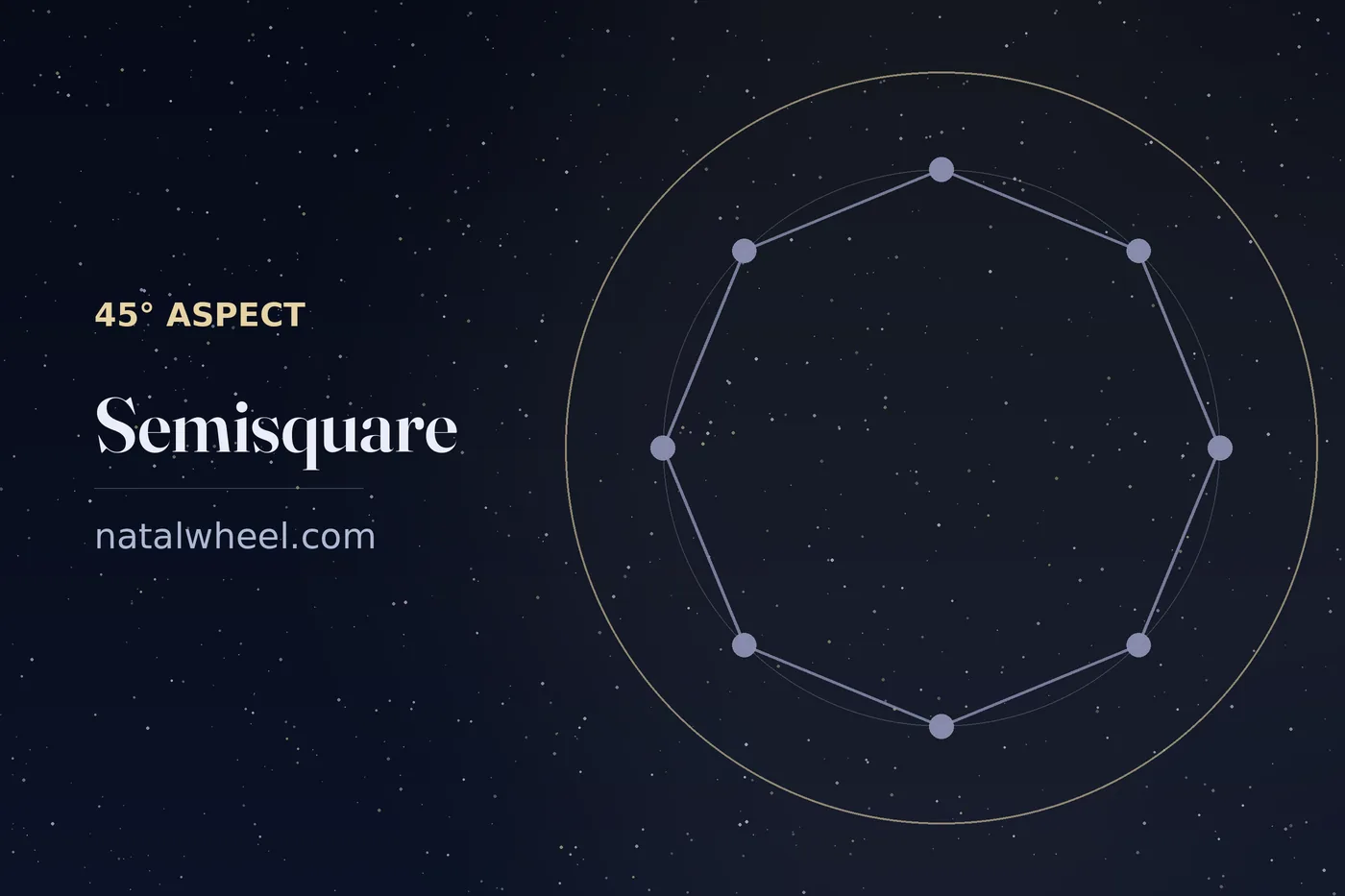
45° · minor aspect
The semisquare in astrology
The semisquare places two planets forty-five degrees apart, half the distance of a square. It belongs to the eightfold division of the circle rather than to the ancient set, and it is read as a minor version of the square's friction: something that nags rather than confronts. Twentieth century cosmobiology gave it more weight than most schools do.
In plain words
A semisquare is a small tense angle: a minor irritation between the two planets. Any two planets in your chart can make this angle. The closer the angle, the more you feel it.
Full guide
An eighth of the circle
Forty-five degrees is one eighth of three hundred and sixty, and half of the ninety degrees that make a square. The eightfold series continues the halving that produced the square from the opposition, and each step down was traditionally held to yield a fainter and more specific version of the same quality. The semisquare is therefore hard in character by descent, related to the square the way a subdivision is related to its parent.
Its relationship to the signs is where it differs sharply from the ancient aspects. Forty-five is not a multiple of thirty, so a semisquare never corresponds to a fixed distance in signs. Depending on the degrees involved it may fall between signs one apart or signs two apart, which means the element, modality and polarity of the pair vary from case to case and cannot be used to describe the aspect. This is a general property of the minor angles: they are measured in degrees alone, and the sign relationships that give the Ptolemaic aspects their explanatory logic simply do not apply.
Where it comes from
The semisquare is no part of the Ptolemaic five. It appears among the additional angles proposed in the seventeenth century, when Kepler argued for deriving aspects from regular geometric divisions rather than from the inherited list, and it was taken up much later by the Hamburg School and by Reinhold Ebertin's cosmobiology, which built a whole method around the hard eighth-harmonic series and read it on a forty-five degree dial. Outside those schools it is used sparingly.
What practitioners report is low-level abrasion. Where a square presents a problem large enough to demand a decision, a semisquare tends to describe a recurring annoyance, a small mistiming between two functions that never becomes a crisis and never quite resolves either. It is often noticed only after the fact, in the pattern of minor complications around a particular pair of planets.
Two degrees at most
Standard practice holds the semisquare to about two degrees, and one and a half is common among those who use it carefully. A luminary attracts the usual small extension, since the Sun and Moon have always been allowed a broader reach than the planets. The narrowness is not incidental. An aspect this minor carries information only when it is nearly exact, because at wider tolerances any chart contains several of them and none can be distinguished from noise. A semisquare within half a degree may be worth a remark; one at two degrees rarely earns the sentence spent on it.
Saying what the evidence is
The minor aspects, this one included, are the least supported element of the whole technique. They came late, they rest on geometric argument rather than on any accumulated body of observation, and they can be multiplied at will until a chart appears to confirm anything. The reasonable way to hold a semisquare is as a whisper, audible only when exact and never load-bearing. The broader division of aspects into helpful and harmful is equally unsafe. The angles that flow describe what a person manages without effort, which is often precisely what they never bother to develop; the angles that catch describe where the friction is, and friction is the usual condition for growth. Neither describes an outcome.
The orb this app allows
2° by default, plus 2° when the Sun or Moon is one of the two bodies, and half the allowance for asteroids and calculated points. The orb preset in Settings scales the whole table if you prefer to read tighter or wider.
Cast your free chart to see your semisquares →
The other aspects
Conjunction · Opposition · Trine · Square · Sextile · Quincunx · Semisextile · Sesquiquadrate · Quintile · Biquintile
Every page here is computed from the same Swiss Ephemeris that powers the Natal Wheel app — a precise tropical natal chart with transits, progressions, returns, synastry and the traditional techniques, free.