Natal Wheel › Guides › Aspects › Quincunx
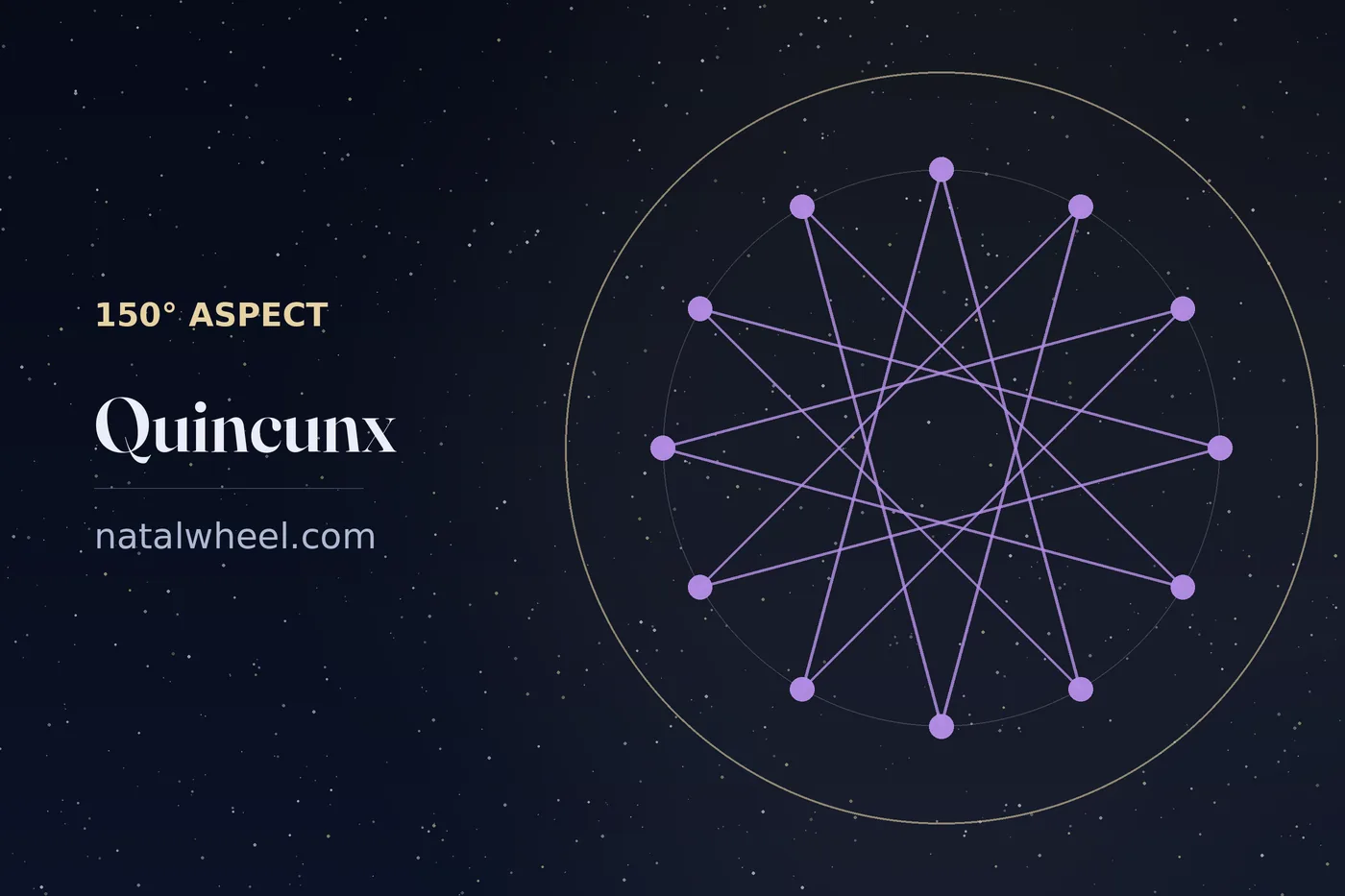
150° · minor aspect
The quincunx in astrology
The quincunx, also called the inconjunct, separates two planets by one hundred and fifty degrees. The signs involved have no element, modality or polarity in common, and classical astrology held that they could not see each other at all. Later practice reads it as a persistent need for adjustment between two functions that never quite align.
In plain words
A quincunx is an awkward angle: the two planets cannot quite see each other, so something needs adjusting. Any two planets in your chart can make this angle. The closer the angle, the more you feel it.
Full guide
Five twelfths of the circle
A quincunx spans one hundred and fifty degrees, which is five signs of thirty. That count lands on the least related sign in the zodiac short of the opposite one. Virgo and Aries, for example, share no element, since earth and fire are not a friendly pair; no modality, since one is mutable and the other cardinal; and no polarity. Every quincunx pairs signs in exactly that condition. The angle is not a clean division of the circle either: one hundred and fifty degrees divides three hundred and sixty into two and two fifths, so the figure has no simple harmonic behind it, unlike the halving of the opposition or the thirds of the trine.
Each planet also stands in quincunx to two signs, one on either side of its opposite, and the two behave differently in some accounts. The relation running back toward the sixth house side is often read as a matter of duty and adjustment, and the one toward the eighth house side as a matter of dependence and consequence, though this refinement is not universally used.
An angle the ancients did not use
The quincunx is not one of the five Ptolemaic aspects. Classical astrology went further than omitting it: signs five apart were said to be in aversion, meaning that planets placed in them literally could not behold one another, and the absence of a connection was itself the reading. The angle entered European practice much later, listed among the additions of the seventeenth century and taken up seriously only in the twentieth, when astrologers writing in English began describing it as an aspect of strain, health and continual small correction.
Read that way, a quincunx describes two functions with no shared vocabulary. Neither can be sacrificed and neither can be made to fit, so the person keeps adjusting the arrangement without ever settling it. Some practitioners associate the aspect with the body and with chronic low-grade complaints, an association that follows the traditional link between the sixth house and maintenance rather than any established evidence.
Kept tight
Orbs for the quincunx are small, typically two to three degrees, and some astrologers hold it to one and a half. The luminaries earn the customary extra degree or so, on the same old reasoning that gives them a wider reach in every configuration. Because the aspect is weak to begin with, tightness is not a refinement but a requirement: a quincunx three degrees from exact contributes almost nothing that the rest of a chart would not supply anyway, while one within half a degree may be worth a sentence. Anything read at a wide orb here is closer to invention than to observation.
How much weight it can carry
This is the point at which honesty about the technique matters. The quincunx and the minor angles are the least evidenced part of aspect doctrine, resting on a much thinner tradition than the Ptolemaic five and on no body of results that would satisfy anyone outside the practice. They are best treated as a whisper: worth noting when exact, never worth building a reading on. The related habit of calling some aspects good and others bad should be dropped as well. Angles that flow describe what a person already manages without effort, and therefore what may never be refined; angles that grind describe where the work happens. A quincunx sits outside that division entirely, and it forecasts nothing.
The orb this app allows
3° by default, plus 2° when the Sun or Moon is one of the two bodies, and half the allowance for asteroids and calculated points. The orb preset in Settings scales the whole table if you prefer to read tighter or wider.
Cast your free chart to see your quincunxs →
The other aspects
Conjunction · Opposition · Trine · Square · Sextile · Semisextile · Semisquare · Sesquiquadrate · Quintile · Biquintile
Every page here is computed from the same Swiss Ephemeris that powers the Natal Wheel app — a precise tropical natal chart with transits, progressions, returns, synastry and the traditional techniques, free.