Natal Wheel › Guides › Aspects › Opposition
180° · Ptolemaic aspect
The opposition in astrology
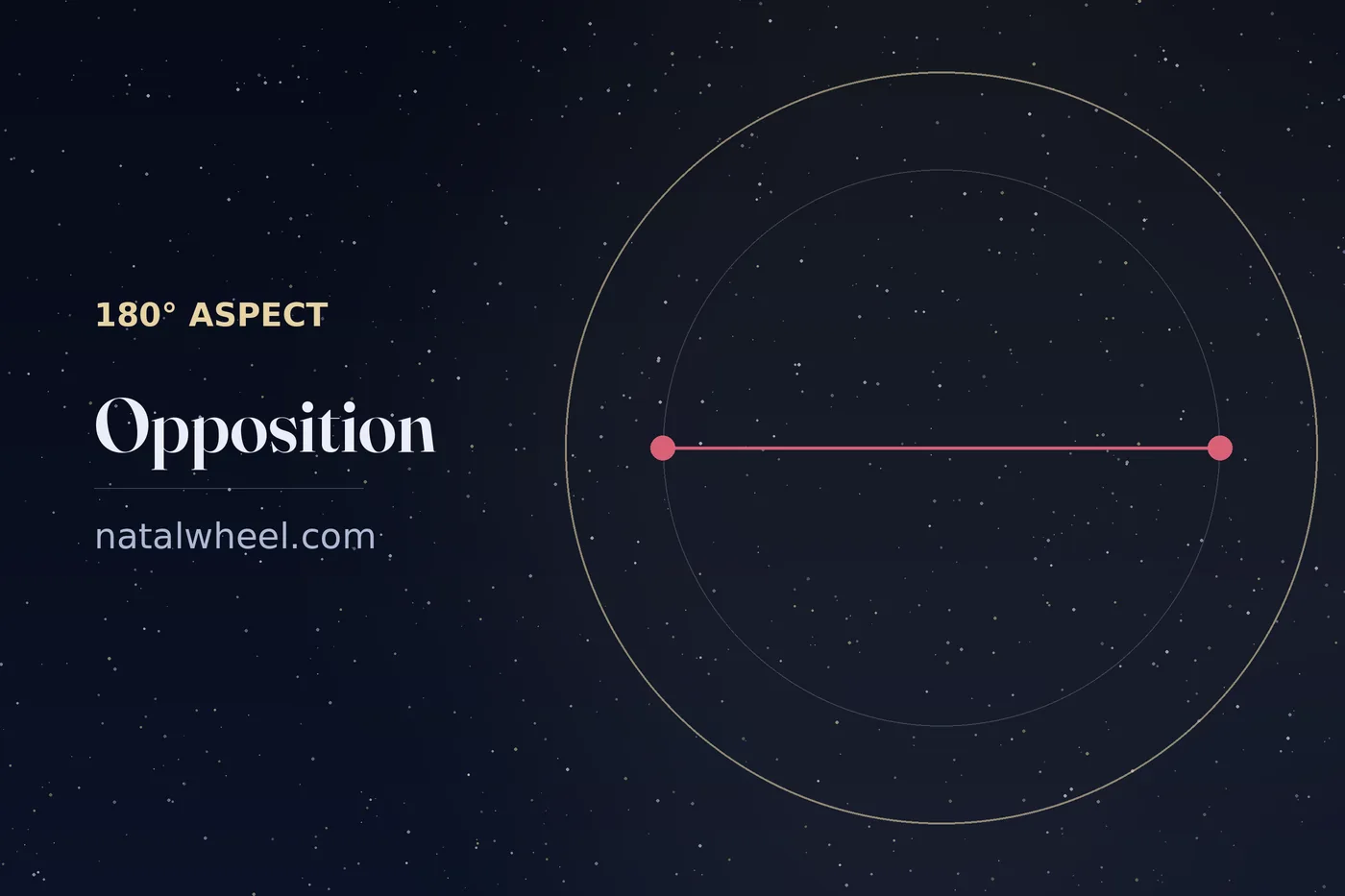
An opposition sets two planets at opposite ends of the same axis, one hundred and eighty degrees apart. The tradition counts it a hard aspect, and in practice it works through awareness rather than force: the two functions are visible to each other, which makes them harder to reconcile and much harder to ignore. Its material tends to surface through other people.
In plain words
An opposition puts the two planets directly across from each other: a tug of war, and a balance to find. Any two planets in your chart can make this angle. The closer the angle, the more you feel it.
Full guide
Half the circle
The opposition divides the zodiac in two, placing one hundred and eighty degrees between the bodies involved. Signs six apart share a modality: Aries faces Libra and both are cardinal, Taurus faces Scorpio and both are fixed, Gemini faces Sagittarius and both are mutable. They share a polarity as well, so fire looks across at air and earth looks across at water, and the elements paired are the compatible ones rather than the antagonistic ones. What differs between them is direction. Each sign carries the half of a subject its counterpart leaves out, which is why the older texts describe the two as complements before they describe them as opponents.
The axis matters as much as the pair. An opposition always falls across a matching set of houses, so its subject arrives with a built-in dilemma of place as well as of sign: the first against the seventh, self and other; the fourth against the tenth, private ground and public standing. Reading only the planets and not the axis loses half the information.
Where it sits in the scheme
The opposition is one of the five Ptolemaic aspects, the ancient core of the technique, and it was classed among the difficult configurations alongside the square. Ptolemy derived the aspects from ratios of the circle and treated the halving as a relation of maximum distance, which the later Latin authors read as enmity. The judgement is coarser than the behaviour. An opposition tends to produce oscillation rather than damage: a person swings between the two ends, over-doing one and neglecting the other, until enough years have passed for both to be held at once.
Because the two planets face each other, the material is unusually easy to see and unusually easy to place outside oneself. The classic pattern is that one end gets lived and the other end gets met in a partner, a rival or a boss who seems to embody it. Nothing in the chart requires that arrangement, and it often loosens once the disowned end has been recognised as the person's own property.
How wide an orb
Eight degrees is the usual allowance for an opposition between two planets, and ten is common enough not to raise an eyebrow. Where the Sun or Moon is involved most astrologers widen the tolerance by two or three degrees, following the ancient idea that a luminary casts a larger body of light than a planet does. The nearer the angle comes to exact, the more of the chart it explains. An opposition within a degree of exactness usually names a theme the person can describe without prompting; one at the outer edge of the orb is a faint pull, and it is a mistake to build a reading around it while a tighter figure sits unexamined elsewhere.
Refusing the usual verdict
Calling this aspect bad and the trine good is a habit of nineteenth and twentieth century popularisation rather than a finding. The honest statement runs the other way round. A flowing aspect describes what a person can already do, and precisely because it costs nothing it is often left at the level it started; there is no pressure to refine it. A tense aspect describes two parts of a chart that grate, and grating produces effort, and effort is where competence comes from. Many people find that the achievements they value most sit on the aspects the older books called afflicted. None of this predicts an event or a relationship, and the geometry never says which ending a story will have.
The orb this app allows
8° by default, plus 2° when the Sun or Moon is one of the two bodies, and half the allowance for asteroids and calculated points. The orb preset in Settings scales the whole table if you prefer to read tighter or wider.
Cast your free chart to see your oppositions →
The other aspects
Conjunction · Trine · Square · Sextile · Quincunx · Semisextile · Semisquare · Sesquiquadrate · Quintile · Biquintile
Every page here is computed from the same Swiss Ephemeris that powers the Natal Wheel app — a precise tropical natal chart with transits, progressions, returns, synastry and the traditional techniques, free.