Natal Wheel › Guides › Aspects › Sesquiquadrate
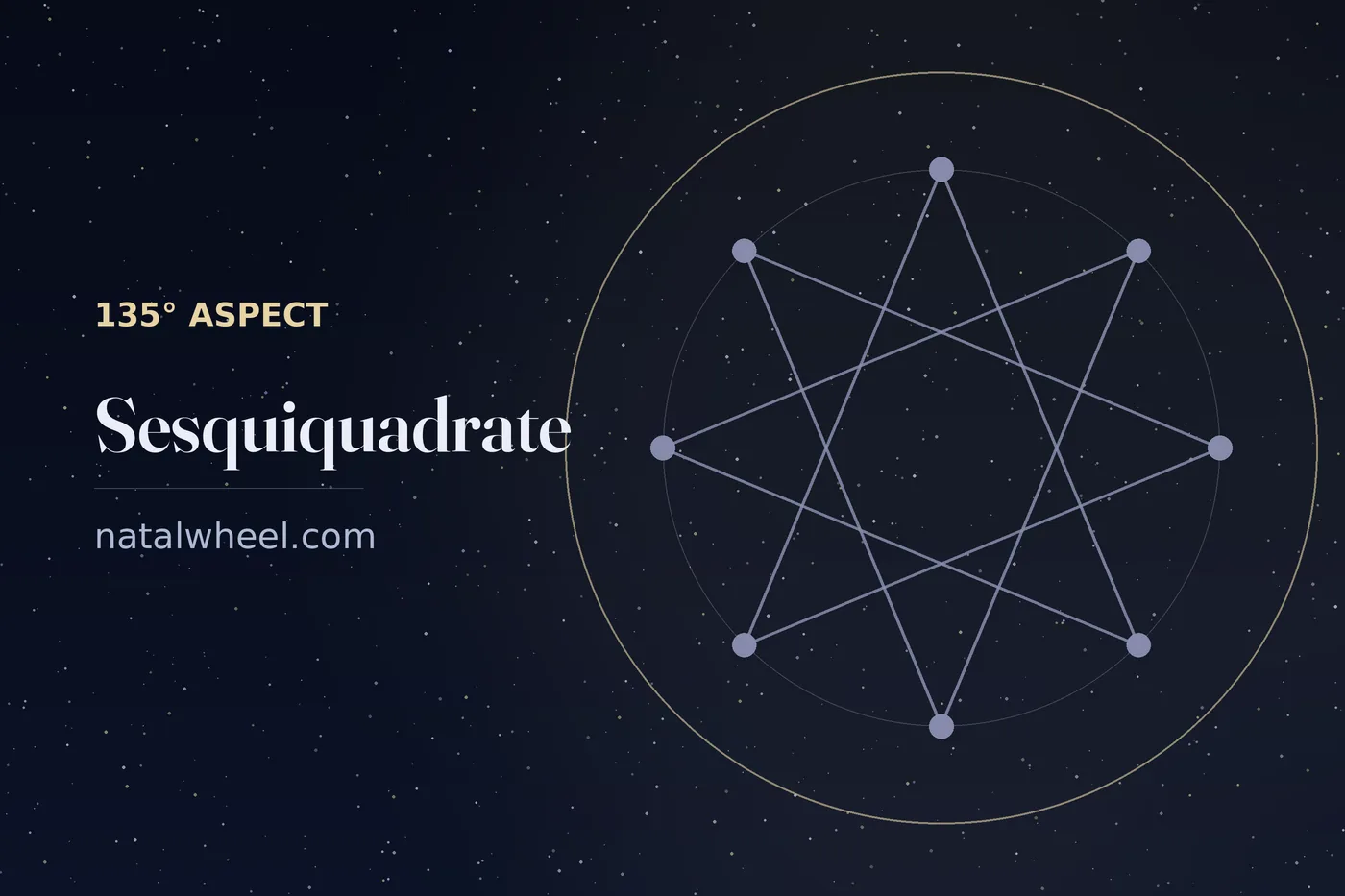
135° · minor aspect
The sesquiquadrate in astrology
The sesquiquadrate, sometimes written sesquisquare, separates two planets by one hundred and thirty-five degrees, which is a square plus a semisquare. It belongs to the same eightfold family as the semisquare and carries a similar quality of irritation, arriving at a wider angle and usually from an unexpected direction. It is a minor aspect throughout.
In plain words
A sesquiquadrate is a small tense angle: a nagging friction between the two planets. Any two planets in your chart can make this angle. The closer the angle, the more you feel it.
Full guide
Three eighths of the wheel
One hundred and thirty-five degrees is three eighths of the circle, and the figure can be read two ways that come to the same thing: ninety degrees plus forty-five, or one and a half squares, which is where the name comes from. It sits in the eighth harmonic series with the opposition, the square and the semisquare, all of them produced by repeated halving, and it inherits the tense character that series is said to carry.
Like every angle that is not a multiple of thirty degrees, it has no fixed relationship to the signs. A sesquiquadrate may fall between signs four apart or five apart depending on the degrees involved, so the pair may look like a wide trine in sign terms while being nothing of the kind by measurement, or may straddle the boundary into quincunx territory. The element and modality of the signs cannot be used to explain the aspect, and any interpretation that leans on them has quietly substituted a different figure for the one actually present.
A later addition
This is not an ancient aspect. The five Ptolemaic configurations do not include it, and the older astrology had no use for the eighth harmonic beyond the square. It enters the record with Kepler's proposal that aspects should follow from regular divisions of the circle, and it was developed most thoroughly in the twentieth century by cosmobiology and the Uranian school, which treated the forty-five degree series as central to prediction. Mainstream practice includes it in aspect lists and usually reads it last.
The behaviour attributed to it resembles a square heard through a wall. Two functions are at odds, but the collision is indirect: the difficulty tends to show up as a consequence of something else, or at an awkward moment, rather than as a direct confrontation between the planets involved. Some astrologers describe it as agitation that a person finds hard to locate.
Orb
Between one and two degrees is the usual allowance, in line with the other minor angles, and astrologers who work carefully with them stay at the lower end. The customary extra tolerance for the Sun and Moon applies here as elsewhere, on the traditional reasoning that a luminary radiates further than a planet. As with any faint configuration, closeness to exact is what separates a reading from a guess. Within a degree the aspect at least makes a specific claim; beyond that, a chart contains enough near misses at one hundred and thirty-five degrees that the figure stops distinguishing one nativity from another.
Where this sits in the technique
The minor aspects are the weakest link in the chain, and a sesquiquadrate should be presented as such: adopted late, argued from geometry rather than from results, and best treated as a whisper that qualifies a reading already established on stronger ground. It should never be the reason for an interpretation. It is also worth resisting the old habit of grading aspects morally. The so-called easy angles report what a person does without effort, and effortless capacities are frequently the ones left unimproved, since nothing has ever pressed on them; the so-called difficult angles report where two parts of a chart refuse to cooperate, and that refusal is where attention, practice and eventual skill tend to gather. Neither kind foretells anything.
The orb this app allows
2° by default, plus 2° when the Sun or Moon is one of the two bodies, and half the allowance for asteroids and calculated points. The orb preset in Settings scales the whole table if you prefer to read tighter or wider.
Cast your free chart to see your sesquiquadrates →
The other aspects
Conjunction · Opposition · Trine · Square · Sextile · Quincunx · Semisextile · Semisquare · Quintile · Biquintile
Every page here is computed from the same Swiss Ephemeris that powers the Natal Wheel app — a precise tropical natal chart with transits, progressions, returns, synastry and the traditional techniques, free.