Natal Wheel › Guides › Aspects › Square
90° · Ptolemaic aspect
The square in astrology
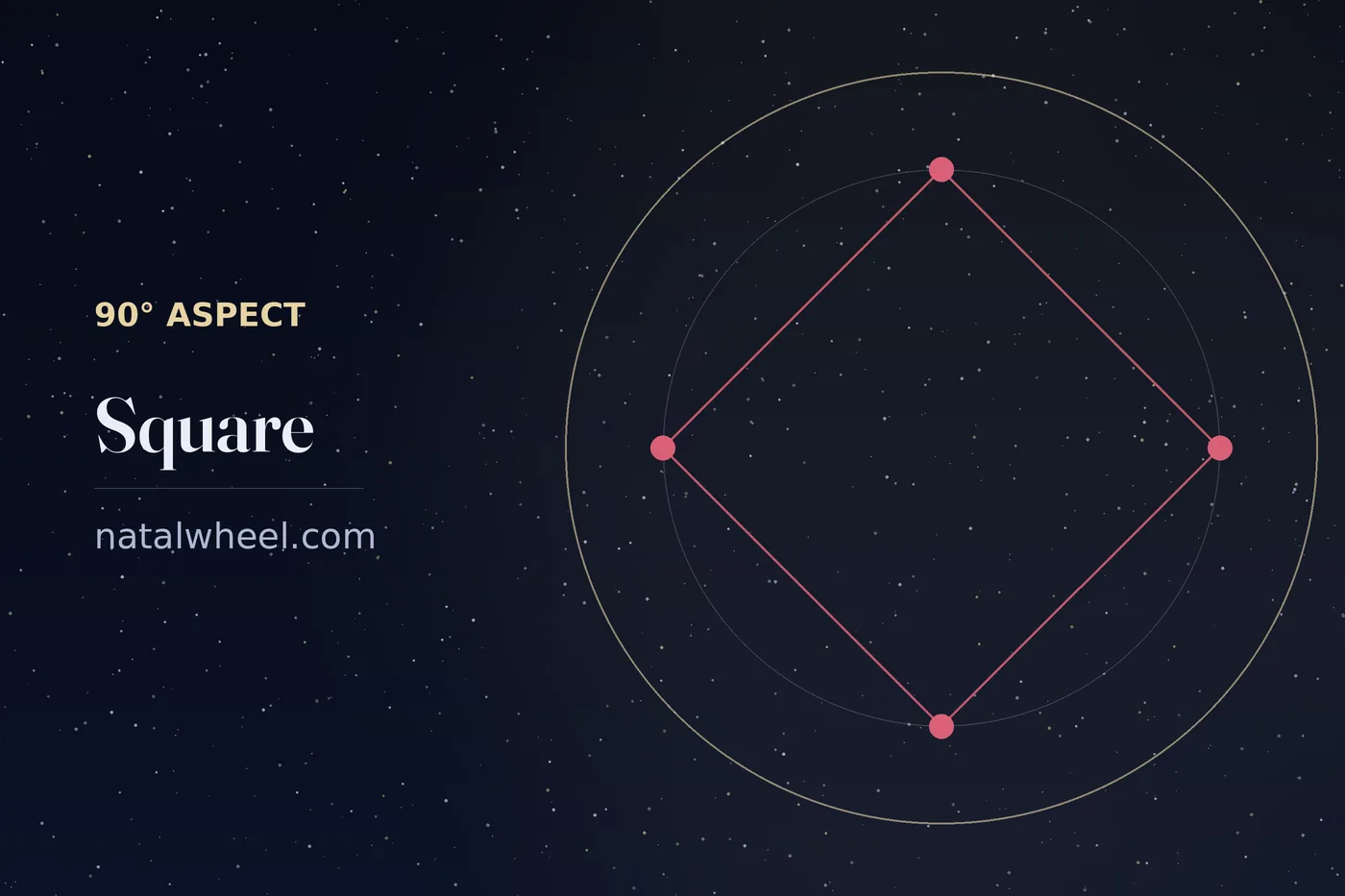
A square sets two planets ninety degrees apart, in signs that share a modality but agree on nothing else. The tradition classes it among the difficult aspects, and it does produce friction; it also produces most of the development visible in a chart, because two functions working at cross purposes cannot be left alone indefinitely.
In plain words
A square is a tense angle: the two planets pull in different directions and something has to give. Any two planets in your chart can make this angle. The closer the angle, the more you feel it.
Full guide
A quarter of the wheel
The square divides the circle into four parts of ninety degrees. Counting three signs along from any point reaches a sign of the same modality but of a different element and the opposite polarity. Aries, Cancer, Libra and Capricorn are the cardinal squares of one another; Taurus, Leo, Scorpio and Aquarius the fixed set; Gemini, Virgo, Sagittarius and Pisces the mutable set. Two signs in square therefore want to operate at the same tempo while pulling toward incompatible ends, fire against water or air against earth. Shared urgency with unshared aims is a good description of what the aspect feels like from inside.
The modality tells much of the story. Cardinal squares tend to argue about what to begin and in which direction; fixed squares dig in, and neither side gives way for years; mutable squares scatter, revising the terms of the argument faster than it can be settled. A square that crosses a sign boundary, so that the two planets are ninety degrees apart but not three signs apart, is called dissociate, and it usually behaves like a slightly muffled version of the same difficulty.
How the tradition treats it
The square is one of the five Ptolemaic aspects, part of the ancient inheritance rather than a later addition. Classical authors placed it with the opposition among the inharmonious relations, and the mediaeval texts sharpened that into language about enmity and affliction that reads badly now. The observation underneath is sound enough. Two planets in square do not accommodate each other, and the person tends to experience the pair as a recurring problem rather than a resource: one function keeps interrupting the other, and neither can be dropped.
What follows from the interruption is the interesting part. Squares generate activity. They are the aspects most often found behind sustained effort, since a difficulty that returns every few years eventually gets worked on, and the working produces capability that no easy angle would have required.
Allowed orb
Seven to eight degrees is the customary tolerance between planets, narrowing to five for astrologers who prefer tight work. A square involving the Sun or Moon is normally granted an extra two or three degrees, on the traditional grounds that a luminary throws its rays further than a planet does. Precision improves the reading considerably. A square within a degree or two is usually recognisable in a life without any prompting, and often turns out to be the central tension of a chart, while a square at the far edge of an eight degree orb should be mentioned lightly if at all, especially when tighter configurations are available to explain the same material.
Friction is not misfortune
The framing that hard aspects harm and soft aspects help is worth rejecting outright rather than qualifying. What a square accurately reports is that two parts of a person do not fit together, and that the misfit will keep asserting itself. That is uncomfortable, and it is also the ordinary mechanism by which anyone gets better at anything. The corresponding truth about the flowing aspects is less flattering than it sounds: they mark abilities that were never tested, and untested abilities frequently stay where they started. None of this amounts to a prediction. A square describes a standing tension between two significations, not an event, a limitation or a fate, and the same angle appears in lives that made very different use of it.
The orb this app allows
7° by default, plus 2° when the Sun or Moon is one of the two bodies, and half the allowance for asteroids and calculated points. The orb preset in Settings scales the whole table if you prefer to read tighter or wider.
Cast your free chart to see your squares →
The other aspects
Conjunction · Opposition · Trine · Sextile · Quincunx · Semisextile · Semisquare · Sesquiquadrate · Quintile · Biquintile
Every page here is computed from the same Swiss Ephemeris that powers the Natal Wheel app — a precise tropical natal chart with transits, progressions, returns, synastry and the traditional techniques, free.