Natal Wheel › Guides › Aspects › Biquintile
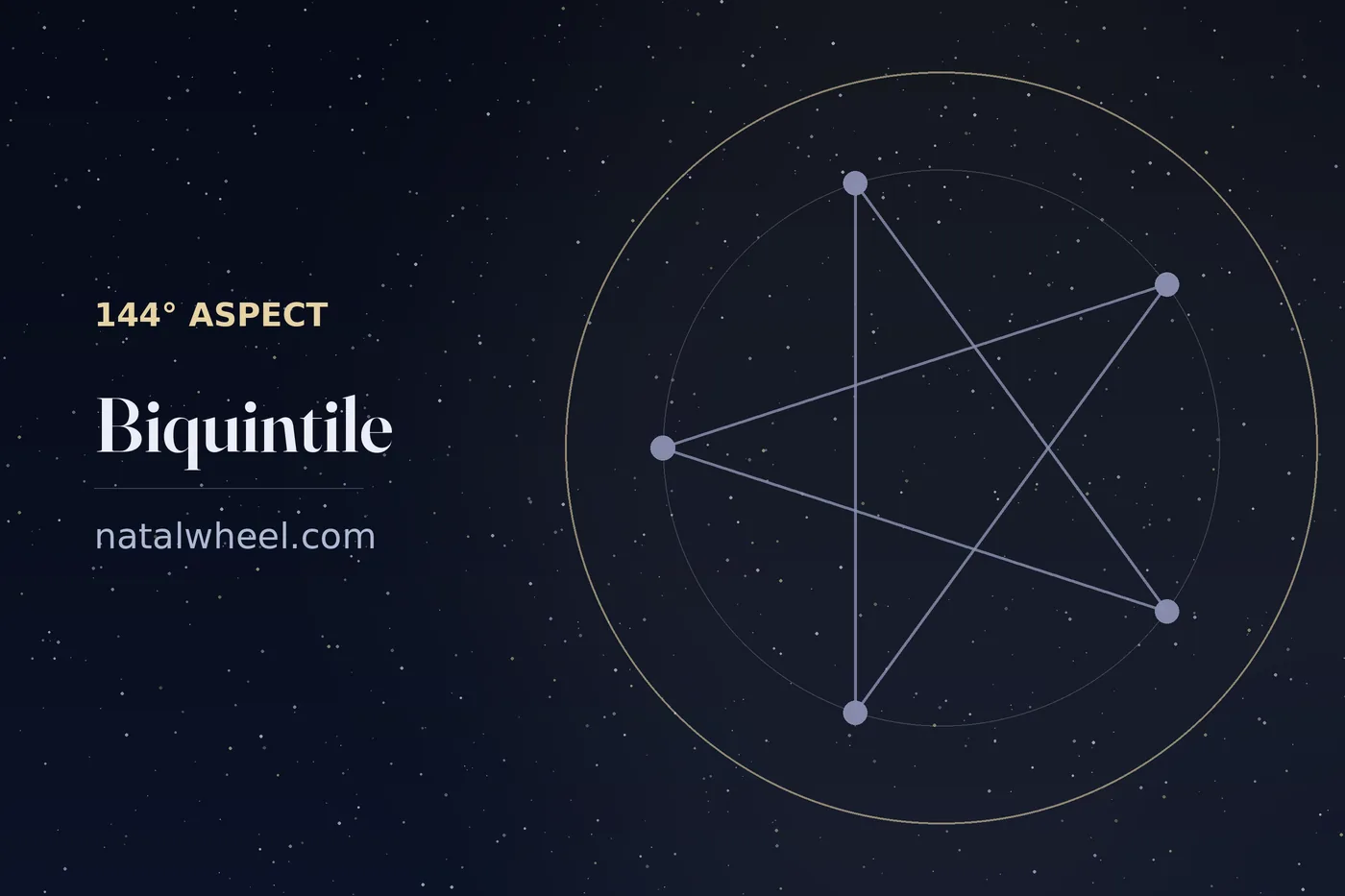
144° · minor aspect
The biquintile in astrology
The biquintile places two planets one hundred and forty-four degrees apart, which is two fifths of the circle and twice a quintile. It comes from the same pentagonal geometry Kepler proposed, and carries the same associations with a distinctive aptitude, held at a wider angle. It is a minor aspect and is read with the same restraint.
In plain words
A biquintile is a small creative angle: the two planets spark ideas in each other. Any two planets in your chart can make this angle. The closer the angle, the more you feel it.
Full guide
Two steps of a pentagon
One hundred and forty-four degrees is two fifths of the full circle, reached by taking two quintiles in succession. It corresponds to the diagonal of the regular pentagon, the line that skips a vertex, and it belongs with the quintile to the fifth harmonic. As with its smaller relative, the angle has no fixed relationship to the zodiac: one hundred and forty-four is not divisible by thirty, so a biquintile connects signs four or five apart depending on the degrees, and the element, modality and polarity of those signs contribute nothing to the reading. Whatever the aspect describes, it does not describe a shared quality between two places in the zodiac.
The measurement should be taken by degree and not estimated by sign. A pair four signs apart looks like a trine at a glance and is a biquintile only within a degree or two of one hundred and forty-four, which is a distinction easily lost when a chart is read by eye rather than by table.
Its origins
Neither the biquintile nor the quintile appears among the five Ptolemaic aspects; both come from Kepler, who set out in the early seventeenth century to reconstruct the aspect list from the geometry of inscribed polygons and the harmonic ratios he associated with them. The pentagon supplied this pair. Astrologers of the last century who adopted the fifth harmonic tended to read the biquintile much as they read the quintile, with the difference put in terms of scope: a facility that operates at some distance from its source, or a talent expressed through material a person did not originate.
Descriptions in the literature vary a good deal, which is itself informative. Where a technique is well founded, practitioners tend to converge; where accounts of an aspect differ this widely, the sensible conclusion is that little has been settled.
Tolerance
A degree or two is the usual limit, matching the other minor configurations, and the stricter figure is preferable. The luminaries are conventionally given slightly more latitude than the planets, an allowance that goes back to the classical idea of their greater radiance. Exactness governs everything here. A biquintile a few minutes from perfect makes a claim narrow enough to be worth testing; one two degrees off is a coincidence of arithmetic, since a chart of ten bodies throws up angles of that approximate size without any significance attaching to them.
Reading it honestly
The quintile family sits at the far edge of what the technique can support. It arrived late, it rests on an argument from proportion rather than on evidence, and it has never accumulated a record that would persuade a careful outsider. It is best treated as a whisper: a possible shade of emphasis on a reading built from the ancient aspects, and nothing that should stand alone. The old practice of calling some angles benefic and others malefic should also be set down. Aspects that cooperate describe what comes to a person unprompted, and unprompted ability is frequently the kind that is never taken further, because circumstances never made an issue of it; aspects that resist describe where two functions grind, and grinding is the ordinary source of whatever competence a life eventually shows. The geometry describes tendencies, not results.
The orb this app allows
1.5° by default, plus 2° when the Sun or Moon is one of the two bodies, and half the allowance for asteroids and calculated points. The orb preset in Settings scales the whole table if you prefer to read tighter or wider.
Cast your free chart to see your biquintiles →
The other aspects
Conjunction · Opposition · Trine · Square · Sextile · Quincunx · Semisextile · Semisquare · Sesquiquadrate · Quintile
Every page here is computed from the same Swiss Ephemeris that powers the Natal Wheel app — a precise tropical natal chart with transits, progressions, returns, synastry and the traditional techniques, free.