Natal Wheel › Guides › Aspects › Semisextile
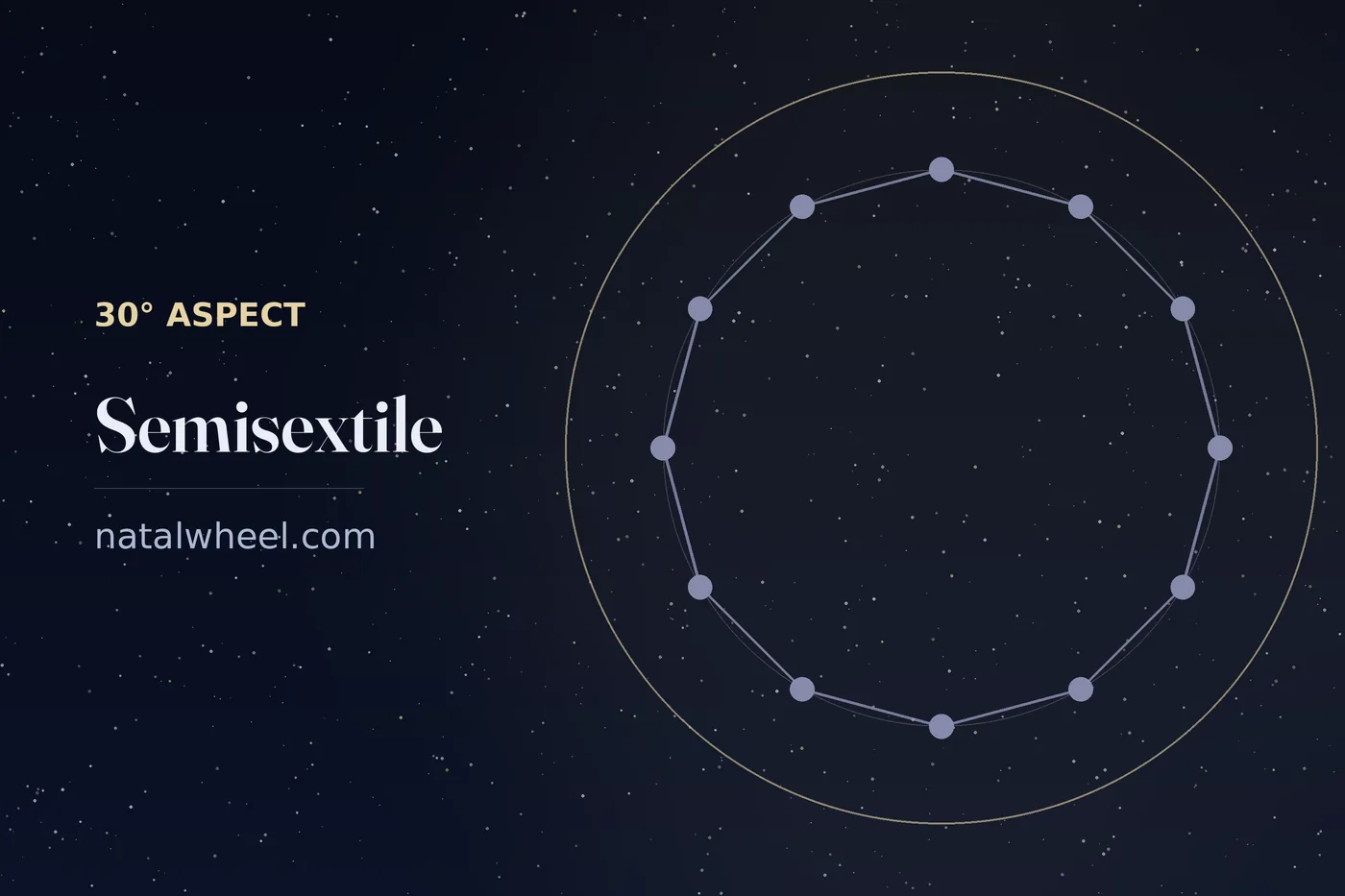
30° · minor aspect
The semisextile in astrology
The semisextile joins two planets thirty degrees apart, in adjacent signs. Neighbouring signs share no element, no modality and no polarity, and the older astrology counted them unable to perceive each other. Modern practice reads the angle as a slight, uneasy contact between neighbours, and treats it as one of the faintest signals in the chart.
In plain words
A semisextile is a small, mild angle: the two planets are neighbours and nudge each other a little. Any two planets in your chart can make this angle. The closer the angle, the more you feel it.
Full guide
One twelfth of the wheel
A semisextile is thirty degrees, exactly one sign. It connects any sign to the one before it and the one after it, and adjacent signs are constructed to have nothing in common: the sequence of elements advances by one, the sequence of modalities advances by one, and the polarity alternates at every step. Taurus and Gemini, Leo and Virgo, Sagittarius and Capricorn are typical pairings. The zodiac is built so that neighbours contrast, which is why the semisextile joins places that agree on no point of description whatever.
The angle is half a sextile, and the halving explains its status. Each further subdivision of the circle was held to produce a weaker relation than the one above it, so a division into twelve stands well below the divisions into two, three, four and six that make up the ancient set. The semisextile is also the smallest separation that counts as an aspect at all in most schemes, sitting just beyond the range where two planets would be read as conjunct.
Aversion in the older scheme
Traditional astrology did not use this figure. Signs one apart were classed in aversion, turned away from each other, and a planet in Leo was simply held to have no line of sight to a planet in Virgo. The blindness was the point: two significations that could not communicate were expected to operate as though the other did not exist. The semisextile arrived with the expanded aspect lists of the seventeenth century and became common only in twentieth century practice, which is a very different pedigree from the Ptolemaic five.
Where astrologers do read it, they usually describe an awkward proximity. The two planets are near enough to be aware of each other and too unlike to combine, and the result tends to show as small recurring adjustments rather than as anything a person would call a theme. Some authors read it as mildly supportive, others as mildly irritating, and the disagreement itself indicates how little the aspect asserts.
The orb it is given
A semisextile is normally held to one or two degrees, and practitioners who work with minor angles at all tend to prefer the narrower figure. The Sun and Moon are conventionally allowed a little more room, as they are throughout the system, since the tradition credits them with a wider body of light. Precision is doing all the work in an aspect this small. Within half a degree the contact is at least specific enough to be tested against a life; at two degrees it is indistinguishable from coincidence, given that any chart contains dozens of angles at that tolerance if one looks for them.
A whisper, at most
The minor aspects deserve a plain statement of their standing. They are the thinnest part of the technique, adopted late, supported by no evidence that would persuade a sceptic, and easily multiplied until a chart says everything and therefore nothing. A semisextile is worth a passing note when it is exact and worth silence otherwise. The same candour applies to the older sorting of aspects into fortunate and unfortunate, which does not hold: flowing angles describe the capacities a person was handed, and a handed capacity is one that circumstances may never have required them to improve, while grinding angles describe the places where effort has actually been spent.
The orb this app allows
2° by default, plus 2° when the Sun or Moon is one of the two bodies, and half the allowance for asteroids and calculated points. The orb preset in Settings scales the whole table if you prefer to read tighter or wider.
Cast your free chart to see your semisextiles →
The other aspects
Conjunction · Opposition · Trine · Square · Sextile · Quincunx · Semisquare · Sesquiquadrate · Quintile · Biquintile
Every page here is computed from the same Swiss Ephemeris that powers the Natal Wheel app — a precise tropical natal chart with transits, progressions, returns, synastry and the traditional techniques, free.