Natal Wheel › Guides › Aspects › Sextile
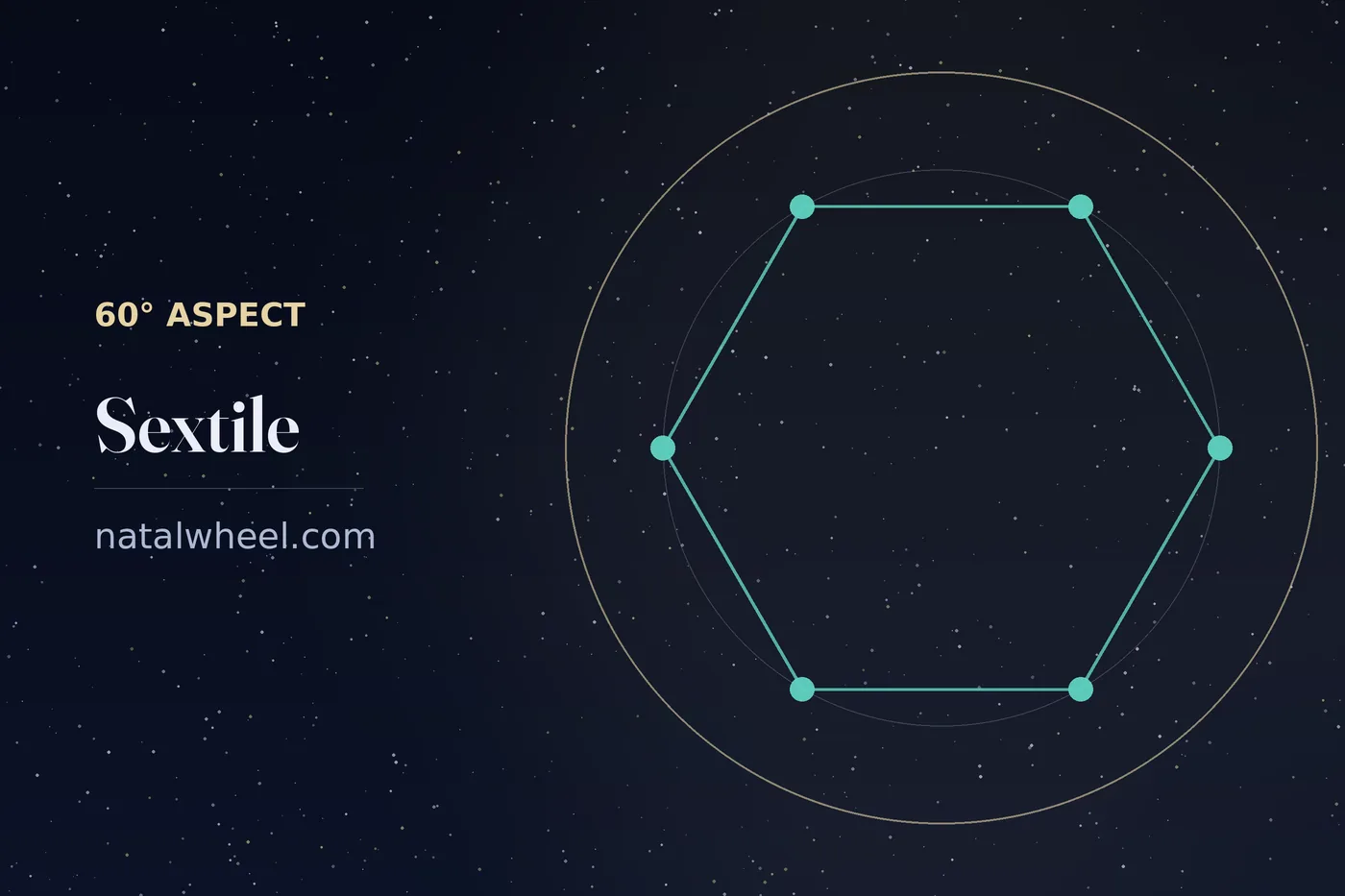
60° · Ptolemaic aspect
The sextile in astrology
A sextile places two planets sixty degrees apart, in signs of compatible elements. The tradition counts it helpful but modest, weaker than a trine and easier to overlook. It describes cooperation that is available rather than automatic: the two functions work well together when a person thinks to combine them, and otherwise sit quietly side by side.
In plain words
A sextile is an easy angle: the two planets get along, if you make a move. Any two planets in your chart can make this angle. The closer the angle, the more you feel it.
Full guide
Sixty degrees, two signs apart
The sextile is a sixth of the circle, and counting two signs from any starting point arrives at it. Signs in sextile share a polarity and belong to elements the tradition regards as friendly: fire with air, earth with water. Aries sextiles Gemini and Aquarius; Taurus sextiles Cancer and Pisces. The modalities differ, as they must, since the two signs are two steps apart in a repeating sequence of three. The result is a pairing with enough in common to cooperate and enough difference to be worth combining, which is the geometric reason the aspect reads as constructive rather than merely comfortable.
It is worth noting how much weaker this relation is than the trine, given that both join agreeable signs. The trine sits on a division of the circle into three, the sextile on a division into six, and the tradition consistently treated the smaller division as the fainter influence. The sextile also lacks the elemental identity that makes a trine so effortless; friendly is not the same as identical.
Standing in the technique
The sextile is the fifth of the Ptolemaic aspects and the mildest of them. Ancient sources classed it as benefic but of moderate strength, and some authors treated it as roughly half a trine in effect. Later writers described it as the aspect of opportunity, which captures its particular quality: the connection is real, but it waits to be taken up.
In a chart a sextile shows as a pair of functions that assist one another whenever they are deliberately brought together, and that go unnoticed when they are not. A person may go years without discovering that two areas of their life reinforce each other, and then discover it in an afternoon. This is why the sextile is often mentioned in connection with skills learned rather than talents possessed: it describes something usable, not something already in use.
A narrower allowance
The orb given to a sextile is smaller than that given to the major hard aspects, usually four to six degrees, and some practitioners hold it to three. Aspects involving the Sun or Moon are widened by a degree or two, since the luminaries have always been credited with a broader reach than the other bodies. Because the tolerance is tight to begin with, exactness carries proportionally more weight here than elsewhere: a sextile a degree from perfect is worth reading, while one at five or six degrees is faint enough that a chart rarely needs it. The general rule holds that the closer the angle, the more of a life it accounts for.
What ease conceals
The sextile is the aspect that most tempts an astrologer into the language of good fortune, and that language does not deserve the confidence placed in it. Aspects described as soft report the combinations a person finds natural, and what is found natural is frequently left undeveloped, because it never presented itself as a problem to solve. Aspects described as hard report combinations that resist, and resistance is what generates the work that turns an inclination into something a person can rely on. Neither category is a blessing or a penalty. A sextile names a compatibility between two parts of a chart, held as a tendency, and it says nothing about whether that compatibility will ever be put to any use.
The orb this app allows
5° by default, plus 2° when the Sun or Moon is one of the two bodies, and half the allowance for asteroids and calculated points. The orb preset in Settings scales the whole table if you prefer to read tighter or wider.
Cast your free chart to see your sextiles →
The other aspects
Conjunction · Opposition · Trine · Square · Quincunx · Semisextile · Semisquare · Sesquiquadrate · Quintile · Biquintile
Every page here is computed from the same Swiss Ephemeris that powers the Natal Wheel app — a precise tropical natal chart with transits, progressions, returns, synastry and the traditional techniques, free.